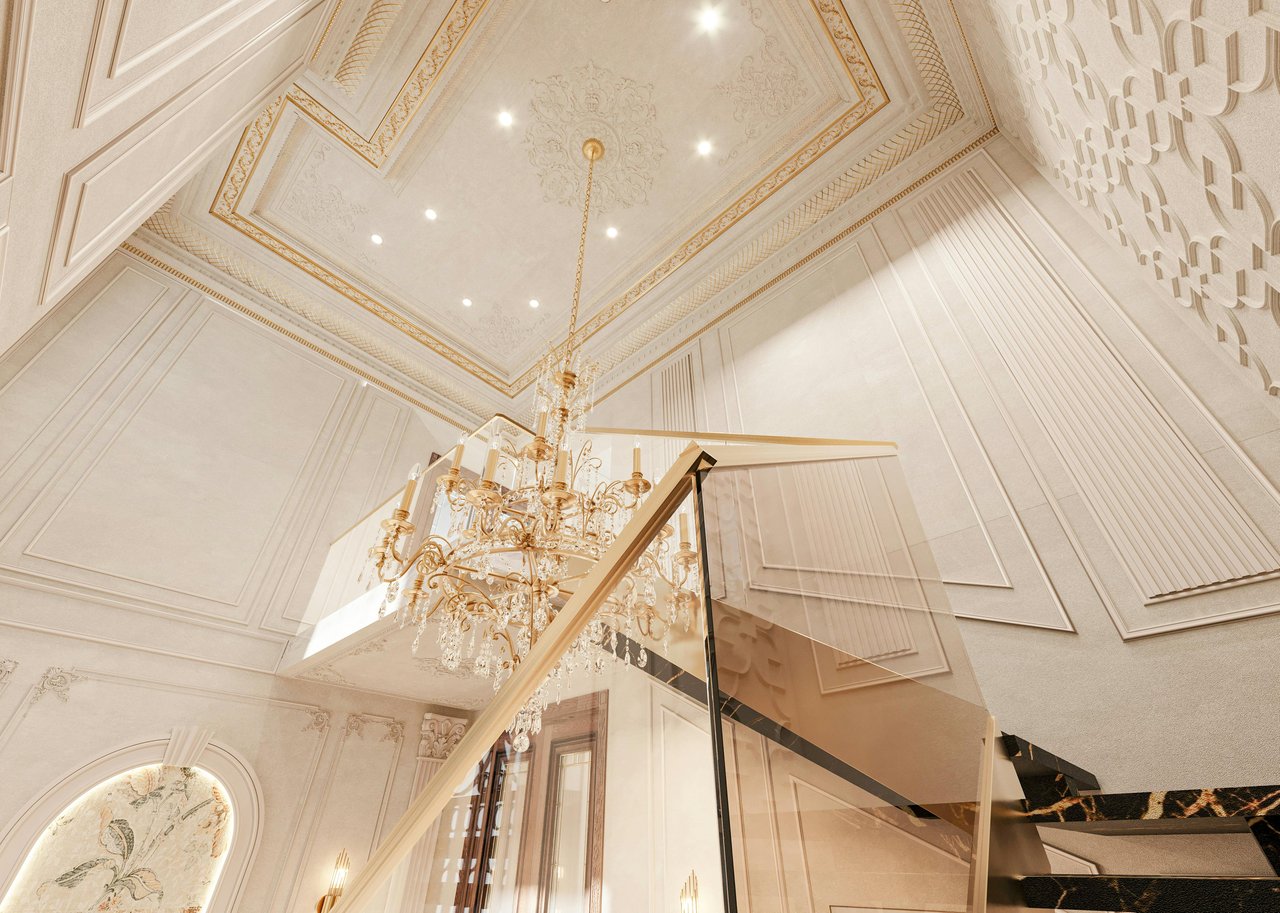
Alisa Goldsmith Interior Design creates spaces that feel layered, livable, and deeply intentional. Every project blends timeless design with modern sensibility, resulting in interiors that reflect how you live, beautifully and authentically.

These 17 Modern Coffee Bar Ideas Will Leave You Seriously Impressed (and Overcaffeinated)

Jessica Davis, founder of the women-led ELLE DECOR A-List firm Atelier Davis, tells us she “love[s] to use warm wood and a really unique stone for the counter surface” of coffee bars. Based on this picture, it’s not hard to see why. The pocket-size niche also proves the theory that bigger and bolder is not always better when it comes to creating the perfect spot for your daily coffee-chugging routine.
Actually low on space? Per Davis, use what you can. “In a tiny space I like to use a small vintage furniture piece for a coffee bar. Maybe a little dresser with drawers...or even a vintage bar cart,” she says.
This collab between wine and coffee makes for a perfect day-to-night transition, without ever leaving the kitchen. Especially worthy of a mention are the coffee bar’s marble backsplash and backlit shelves. The latter adds an undeniable element of moody sexiness to the whole tableau; in conjunction with the rich aroma of coffee beans, the whole thing becomes simply irresistible.
In this sleek and chic kitchen by Liz Potarazu of the Maryland-based design firm LP & Co, the coffee bar is in “incognito mode,” surrounded by floating shelves that display art objects versus kitchen essentials. Per Potarazu herself, “Creating a space for a coffee machine and its accessories within your kitchen cabinetry, complete with pocket doors or a lift-top door, provides you with all the function of a coffee bar without showing any of the mess that can go into it.” When paired with open shelving, it makes “a beautiful yet functional space for your morning routine.” We absolutely couldn’t agree more.
Especially in small quarters, you have to make do with limited opportunities for expansion when it comes to creating your dream coffee bar. This one, which works in unison with the sink, has a kind of old-school charm to it: all vintage lamps and trinkets and warm wood panelling. It's your excuse to mix-and-match decor elements you already have at hand—displaying them proudly next to the main event (the actual coffee maker!).
This coffee bar setup is not only space-saving but also budget-friendly. All it takes to replicate the look is a simple storage cart—which you can tuck into the corner of even the smallest apartment kitchenette—and all the fixin’s you need to make your coffee experience worth it each time. Not a fan of anxiety-inducing caffeine? Use this storage solution for your tea habit too by tastefully displaying loose-leaf tins or accessories like matcha whisks.
Imagine making your fancy-shmancy coffee here and then taking it a literal two steps over to sip while answering some work emails. With this kitchen-slash-office setup, courtesy of D.C.-based architecture and design company Third Street Architecture, you can. That undercounter fridge and those charming pendant lights? Priceless additions to any modern coffee bar design.
Ran out of counter space? Hit the antique mall this weekend and scavenge for a vintage cabinet that can accommodate everything from your coffee maker to glassware (for those iced lattes, duh!). There’s something so markedly retro about this coffee bar look, and it surely doesn’t take much to achieve similar results in your own abode.
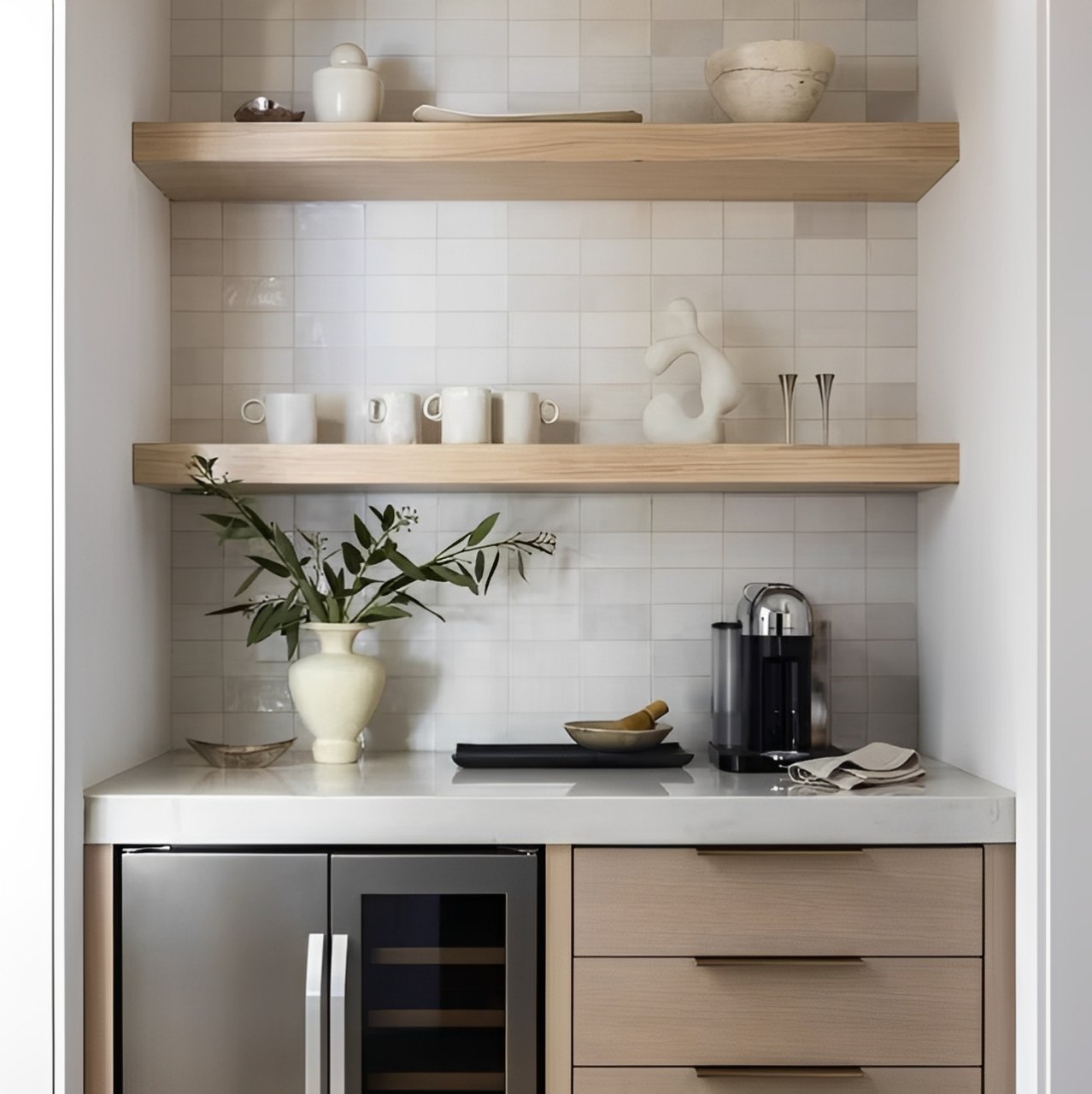
Making a statement in your kitchen via bold tile backsplashes is nothing new, but this particular coffee bar is an anti-statement in a way: subtle and demure as it is. “For this project we used zellige [tiles] for the backsplash, quartz slab for the countertops, and white oak and brass hardware—bringing warmth to a purposely seamless design,” says Pascale de Fouchier of Pascale de Fouchier Interiors. Mugs, vases, and other objects that match the tiles’ hue make the whole look even more picture-perfect.
You’ve probably heard the legend that if you skip out on your $7 daily flat white, you could eventually become a millionaire (validity of that statement very much pending). If you do, indeed, choose to embark on this get-rich-quick experiment, having a coffee bar that basically replicates coffee shop interiors will make it easy. Here, the look is made complete via a peg letter board and a sign that takes us back to mid-aughts Tumblr. Embrace the nostalgia, and don’t forget to add fresh florals, like this orchid, for good measure!
Think coffee bars are only reserved for kitchens? Think again. This one, created by Dana Schwartz, who runs an eponymous design firm, is actually in the middle of a hallway of guest bedrooms (because going all the way to the kitchen for your daily dose of energy is too much work).
“The wallpaper and the paneled appliance cabinetry mimics the wood tones of the hallway,” Schwartz tells ELLE DECOR. “Instead of doing closed cabinetry above the bar, we opted for floating brass shelves to modernize and add a touch of glam to the warm tones. We also included refrigerator drawers in the bar for ease of use and storage.”
While mismatched tchotchkes littering your kitchen counters or coffee bar have readily apparent charm to them, sometimes going the matchy-matchy route is preferable. Most gadgets in this space, kettle and espresso machine included, are eggshell colored and glossy. This aesthetic, in turn, goes seamlessly hand in hand with the cabinets. Perfection.
This coffee bar visual, as part of a kitchen’s renovation in Great Falls, Virginia, shows that having a lot of appliances doesn’t necessarily detract from the suaveness of the space...as long as you properly embed them. “The drawer inserts and pull-out shelves were custom designed to perfectly fit [the clients’] coffee makers, toaster oven, mugs, and all other needed items,” says Kate Donahue, architect and team leader at Four Brothers Design + Build, the company behind this design. The nook’s white oak interior finish marvelously contrasts with all that stainless steel.
Coffee bars in bedrooms? Anything is possible! In this cozy project by Carrie Moore Interior Design, the luxury of coffee in bed—every single day—is made all the more accessible. “When the doors open, a built-in, fully automatic coffee maker is revealed,” Moore describes. “The small space also has a sink, panel-ready drawer dishwasher, panel-ready refrigerator drawer, and storage cabinets for...coffee accoutrements.” In other words, enough bells and whistles to fully justify your bed rot.
As far as what Moore thinks is essential to have in any coffee bar: “bean storage, a grinder, a coffee/espresso maker of choice (whether it’s a simplistic pour-over carafe, top-of-the-line espresso maker, or a fully automatic maker), a milk frother, a place to discard used grounds, and mugs!” Brb, adding all of that to cart.
This coffee bar situation—crafted by Gabriela Eisenhart, principal designer at Silo Studios—is kind of glam, let’s be real. The cabinetry colors and pink teapot make a perfect match, especially in the context of that white subway tile backsplash. For those who don’t know how exactly to proceed with their own coffee bar endeavors, Eisenhart has some precious advice: “Treat the coffee bar like you would the kitchen design, but avoid overcomplicating it since coffee machines already have a strong visual presence. Choose a clean, natural stone for the countertop and an easy-to-wipe backsplash.” Check, check, and check.
White oak finishes seem to be the common thread that runs through many coffee bar ideas in this roundup, and we’re not mad about that. After all, just look how subtly elegant the wood is in this arrangement by MV Architects. Go a step further and echo the surface’s hue in nearby decor elements, like the dining chairs. A kitchen this nice will have you setting all your future alarms to 6 a.m.
We know, we know: This isn’t technically a coffee bar. But use your imagination for a sec and pretend the top-shelf liquor lining those shelves is actually a selection of the finest roasts. We pulled this visual—from Timothy Haynes and Kevin Roberts’s reno of a London townhouse—to illustrate the beauty of using mirrors and silvery mosaics to create a coffee nook. All your guests will be jealous.
Morning coffee, but make it highbrow. In this wet bar, from a Studio Piet Boon–designed home in Amsterdam, the red sculptures by Lars Zech and Lieve Rutte, from left to right, are just the cherry on top that was needed. The mirrored backsplash and Gaggenau wine cooler also contribute to elevating the scene. You can use the cooler, by the way, to store nut milks instead of alcohol!
Tambour paneling might be the perfect solution if you're seeking a fresh alternative to wallpaper and paint
If you want to make a statement in a room blessed with curves or architectural pillars, tambour paneling is the perfect choice. Its flexible design, which is arguably its most captivating feature, makes it an incredibly achievable and striking way to transform those tricky, curved spaces that are often difficult to customize.
When paint just doesn’t provide the texture or dimension you’re after, tambour is the ideal solution. Pernille Lyk from Københavns Møbelsnedkeri explains, ‘The practical aspect of easily concealing a workspace, combined with the aesthetic appeal of unbroken slat sequences and the playful motion of cabinets that bend around corners, makes tambour an exciting material to work with.’
Designed to flex and conform to rounded walls, cabinetry, and columns, tambour creates smooth, uninterrupted swathes of texture and delivers a polished, professional finish that is surprisingly easy to achieve at home without the need for a master craftsman (or the cost that comes with one!)
A feature wall is an ideal way to breathe life into a room. When used from floor to ceiling, it becomes a true showstopper, drawing attention and creating a focal point that offsets furniture in a way that paint simply can’t.
Not only does it add texture, depth, and warmth to a room, but it's also remarkably easy to install. The trickiest part is ensuring you’ve measured the number of panels you need, and after that, it's a straightforward process of gluing and nailing the panels into place. With minimal effort and a little planning, you can achieve a major design impact with this DIY-friendly project.
One of the most appealing attributes of tambour paneling lies in its endless customization options, including a wide range of color choices. For those looking to inject a touch of 1970s chic into their space, these walnut wood fluted panels from Wood Veneer Hub are the perfect starting point. Walnut’s rich timeless shade beautifully complements the darker, moodier textures that define 20th-century retro-style interiors.
Fluted tiles can be found in plentiful supply and many pieces of built-in and standalone bathroom furniture feature tambour details.
However, tambour works beautifully as a wall feature independently, and it offers a refreshing alternative to the typical tile and paint options often found in a bathroom scheme. Used in the right way and in the right amounts, it gives off a serene, spa-like atmosphere, reminiscent of a sauna.
As Interior Designer, Pascale De Fouchier reflected on the space she designed, ‘Here, the goal was to create a spa-like ambiance, but also to make the room feel more spacious with higher ceilings, which was achieved thanks to the vertical lines. It brings texture and warmth in a flowing yet seamless way, creating a sense of calm and continuity. The lighter choice of wood complements the existing cabinetry and gently contrasts with the soft-toned countertops and floors.'
There's an emerging trend of tambour paneling being used as a headboard. Its appeal in the bedroom is its relatively simple ability to create a big statement. You could use tambour paneling to create a framed headboard or to cover an entire wall for a more immersive feel.
The style's versatility allows it to be customized to fit your bedroom design scheme, with an expansive range of options for size, finish, making it a rather popular choice for the DIY inclined.
Whilst installing these panels horizontally is the most popular configuration, the possibilities are endless with this material and a vertical headboard could be just as impactful if you needed to create height in a room.
As interior designer Monica Tostes explains, ‘One aspect of tambour paneling that I find particularly appealing is its soft, warm appearance and the ease with which it can be adapted to different design schemes and wall shapes. Furthermore, depending on whether it is installed vertically or horizontally, tambour paneling can help create visual illusions that alter the perceived length or height of the room.'
If a feature wall is too overwhelming for your space but you still want to explore the tambour trend, using it to add a little interest to furniture is an excellent way to introduce it in smaller doses.
Tambour has long been a staple in furniture design, all the way back to the 1700s in fact, and you can see it in many historical designs as well in modern pieces with Mid-century designs being highly sought after. But incorporating tambour into your own pieces can be a lovely way to bring the style into your home if a more bespoke solution is what you’re after.
It’s also incredibly effective when used on built-in cabinetry, really elevating what could be a purely functional feature into a stunning design element. As Oliver Haslegrave from Child Studios notes, ‘When used in cabinetry, for example, it offers a refined, understated detail that makes storage more playful and engaging. In this project, our custom tambour paneling was used to create a sense of flow and continuity, highlighting the relationship between traditional craftsmanship and modern form.’
Tambour paneling is the perfect way to elevate any blank wall or make a built in more interesting and textured. While this take on paneling is often seen in more modern spaces, it's really versatile and can work in many spaces and with many styles from uber-modern to Mid-century to classically traditional rooms.
Curated insights on Baltimore luxury real estate, including market opportunities.
Working with Alisa Goldsmith means more than just buying or selling a home—it means experiencing a higher level of service.